On May 2nd, we were about a month past the equinox and into spring. Look West of Northwest at 10:00 PM and the two prominent stars are Castor and Pollux, the twins, which will begin setting before dusk in a month.
The winter constellations, Orion fending Taurus off with his shield (an archipelago of young stars), Canis Major and Minor heeling just behind, have all disappeared below the horizon before sunset.
The last winter constellation to go is Taurus. It is now setting with the sun and directly overhead at noon.
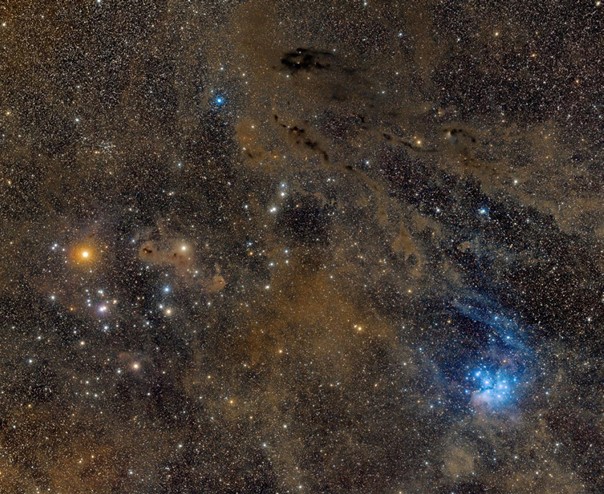
That part of the sky has always motivated curiosity. Aldebaran a double star dominated by a red giant star, the Pleiades and Hyades, open clusters and “nebulae.”
The giant molecular cloud in Taurus is a stellar nursery, relatively close by, as galactic scales go, and easy to study.
There are two requirements for stellar formation, and the cold molecular cloud provides both: material in the form of gas (mostly Hydrogen, H2) and at temperatures near absolute zero. The cold allows for a nearly condensed state of matter, so interstellar gas can accrete into clumps from the effect of gravity alone—any heat would overcome that effect. The gravitational collapse continues from this moment throughout the stellar lifetime. As random, gravitational singularities begin grow (hydrogen molecules accreting into increasingly dense material) the collapse continues until there is enough mass and density to start a thermonuclear reaction (it is a lot)—and a star is born.
Chinese observers in 1054 catalogued a spectacular “guest star” in Taurus. It was a supernova 6000 light years away (luckily for us) and is now referenced as SN 1054, for the supernova of 1054. It was seen everywhere, as it was so bright that it was visible in full daylight for nearly a month, and at night for almost two years.
As a star continues to collapse into itself, the energy from a cascade of thermonuclear reactions within the star pushes back against gravity, creating an equilibrium that sustains the stellar envelope. The pressure created by this oppositional force, gravity versus energy from the stellar furnace, continues to fuse nuclei together to create heavier and heavier elements but the process can only go so far. There is not enough energy for creating any element heavier than iron; the stellar spin down reaches its end, and the gravitational-spatial collapse resumes. Eventually the star collapses into a singularity, suddenly and catastrophically (literally, in seconds) and rebounds as a supernova event. But even the energies of the supernova are not enough to create elements heavier than iron.
The glowing remnants of SN 1054, comprising the Crab Nebula, might have been visible to the unaided eye seven hundred years later. By the 1780s, optical astronomers were reporting inconsistent observations of comets and nebulae. A new “comet” would be discovered, only to persists as a nebula, not a comet. Charles Messier, a French astronomer working in England, decided to develop a catalog of the nebulae as a reference for comet-hunters. He would end up with an atlas of 110 objects.
The first place he would look was towards the famous object in Taurus, giving it the first entry in his catalogue: the first Messier object, M1, the Crab Nebula.
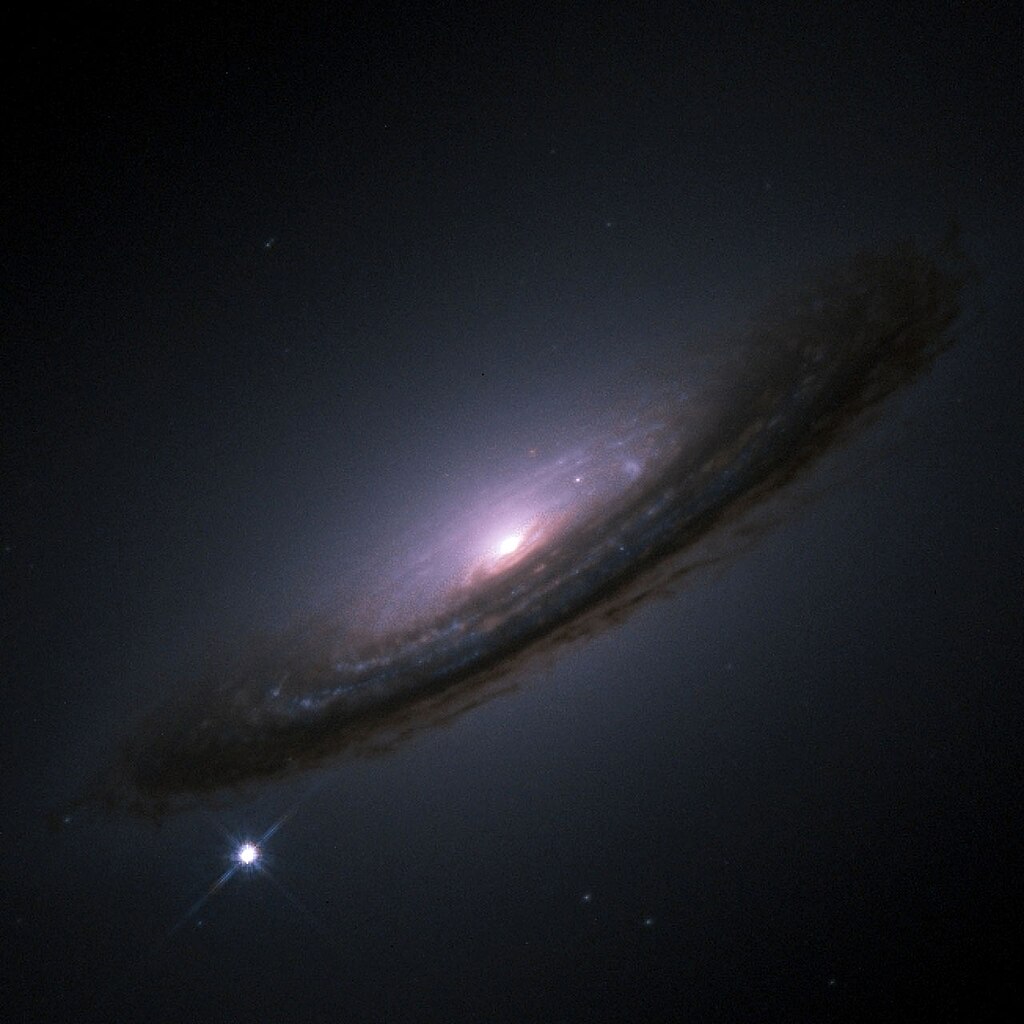
The mass of the star affects its eventual fate. If it is massive enough, the final gravitational collapse of the star, results in the cataclysmic rebound we call a supernova. A supernova event can outshine its entire galaxy, for a few days or weeks. What is seen in visible light, are the glowing remnants of the ejecta.
The remaining core, which exists in a condensed state of matter, is a rapidly spinning neutron star. It still has most of the mass and angular momentum of its predecessor. The result is an object with a mass a couple of times that of our sun, condensed to a scale of about 10 to 20 kilometers in diameter. Since angular momentum is from the progenitor star is conserved in the remnant core (think of a spinning figure skater bringing the arms in to spin faster), the neutron star spins at relativistic speeds on the order of once every 1.8 seconds, behaving like a giant magnet (or “magnetar”), and like a spinning armature with enough power to shred the surrounding space into streams of paired matter and antimatter particles.
The first radio observation was a mysterious signal detected in 1968 at the Arecibo Radio observatory in Puerto Rico. The 1.76 second periodicity of the signal of the “quasi-stellar radio object” (a quasar) was a special case: one of the first “pulsars,” a spinning neutron star.
May 5th: More to follow, soon. Neutron Star collisions and matter.

The heartbeat of the crab nebula, a three-month time lapse sequence collected by the Hubble Space Telescope in 2005.

 cognitiveterrain